Many of my friends are scared of AI taking their job in programming, so I decided to write this article. In an IBM study, it states: "More than three in four executives say entry-level positions are already being impacted, while only 22% say the same for executive or senior management role."
This study, and many others, already confirm what we know: executives/managers are pushing for AI to replace developers despite their experience, due to incentives or sheer incompetence. Their arguments are often based on lies, manipulations, and hype.
They claim AI is better than you, but AI has been better than us since 1949, as detailed on page 7 of "Giant Brains or machines that think" by Edmund C. Berkeley:
The Kinds of Thinking a Mechanical Brain Can Do
There are many kinds of thinking that mechanical brains can do. Among other things, they can:
- Learn what you tell them.
- Apply the instructions when needed.
- Read and remember numbers.
- Add, subtract, multiply, divide, and round off.
- Look up numbers in tables.
- Look at a result, and make a choice.
- Do long chains of these operations one after another.
- Write out an answer.
- Make sure the answer is right.
- Know that one problem is finished, and turn to another.
- Determine most of their own instructions.
- Work unattended.
They do these things much better than you or I. They are fast.
This also applies to things like calculators, chess programs, and Go AI.
The Reality of AI in Business
In a report conducted by MIT, "STATE OF AI IN BUSINESS 2025," this report uncovers a not-so-surprising result: 95% of organizations are getting zero return. Tools like ChatGPT and Copilot are widely adopted, with over 80 percent of organizations having explored or piloted them, and nearly 40 percent reporting deployment. However, these tools primarily enhance individual productivity, not P&L performance.
Measuring AI Automation in Remote Work
A new study, "Measuring AI Automation of Remote Work," highlights that while AI systems have demonstrated rapid progress on a variety of benchmarks, it remains unclear how these gains translate into the capacity to perform economically valuable work.
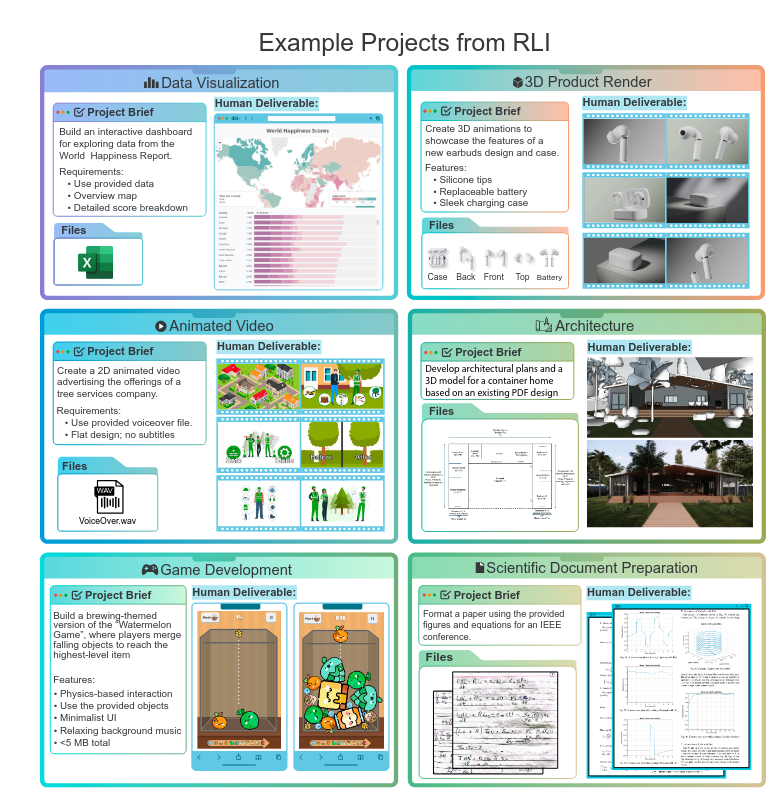
The Remote Labor Index (RLI) represents a broad range of projects from across the remote labor economy, including game development, product design, architecture, and data analysis. All projects represent real work that was performed by human professionals.
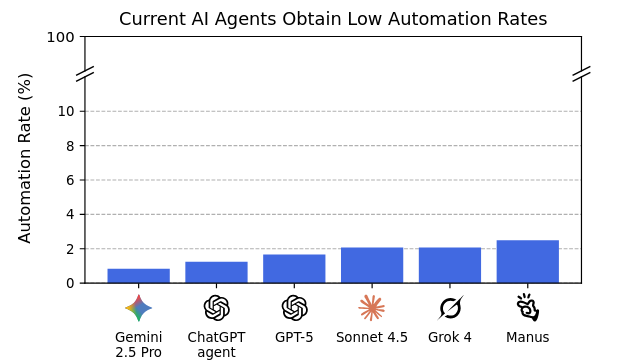
All AI agents tested automate at most 2.5% of tasks on RLI, showing that most economically valuable remote work currently remains far beyond their capabilities. AI is failing at 95% of tasks; that's insane, considering what we were promised about AI taking our jobs. It can't even do 3% of it.
The Impact on Developer Productivity
"Measuring the Impact of Early-2025 AI on Experienced Open-Source Developer Productivity - METR" surprisingly found that when developers use AI tools, they take 19% longer than without—AI makes them slower. Why is that? Because we have to go back and fix all the small details and bugs that AI generates. The code AI generates is just boilerplate, a placeholder for you to go in and make something real out of.
AI and Skill Formation
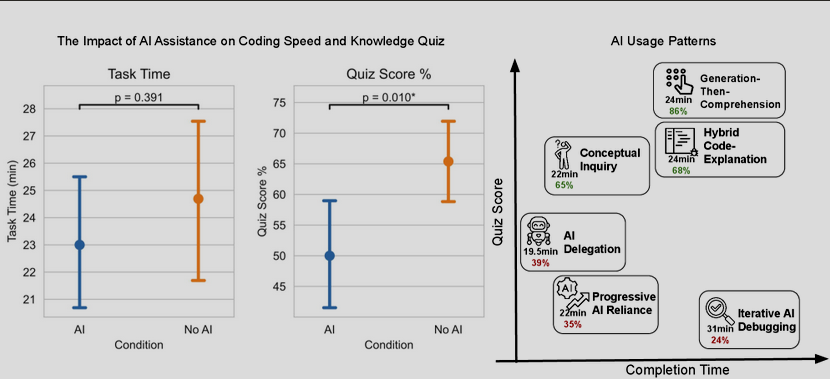
"How AI Impacts Skill Formation" reveals a significant decrease in library-specific skills (conceptual understanding, code reading, and debugging) among workers using AI assistance for completing tasks with a new Python library. (Right) We categorize AI usage patterns and found three high skill development patterns where participants stay cognitively engaged when using AI assistance.
Relying heavily on AI will make you forget your hard-earned skills. If you don't use it, you lose it.
I think in the future we won't have enough skilled seniors, and juniors will rely on AI for everything, making the internet a more buggy place, just like the recent Windows 11 news.
You should read this
"I Audited Three Vibe Coded Products in a Single Day. All Three Had Critical Security Vulnerabilities"